


Customers no longer think in “channels.” They naturally navigate from web to phone, chat to social media, expecting brands to do the same without hiccups or memory lapses. For them, there’s only one company, which should recognize them everywhere.
Yet for many organizations, moving from multichannel to omnichannel remains a complex and daunting project: scattered technologies, siloed data in non-communicating systems, teams still working in silos with their own goals and tools. The road to omnichannel sometimes seems littered with insurmountable technological and organizational hurdles.
Succeeding in your omnichannel transition is above all a global transformation project—human, technological, and organizational. It’s not just a software update or adding a new channel. It’s rethinking in depth how the company understands, serves, and retains its customers.
Here are the five essential levers to turn this ambition into sustainable, measurable success.
Before diving into the success levers, let’s clarify key concepts:
Omnichannel Transition: Transformation process where a company shifts from a siloed multichannel approach to a unified, integrated omnichannel strategy.
CDP (Customer Data Platform): Software platform that unifies customer data from all channels to create a 360° view and enable personalized marketing activation.
Unified Customer Data: Centralized database aggregating all customer information (purchase history, preferences, interactions) accessible in real-time across all channels.
Channel Integration: Technical and organizational synchronization of all customer touchpoints (voice, chat, email, social media) to ensure experience continuity.
Seamless Customer Experience: Frictionless journey where customers switch channels without repeating information or losing conversation context.
RPA (Robotic Process Automation): Automation of repetitive tasks by software robots to free up advisor time.
Omnichannel relies on a core principle: delivering a 360° customer understanding. Impossible to create a connected experience if your data tells different stories across departments. A customer buying in-store, browsing your website, and contacting via chat must be recognized as one person, not three separate entities.
Yet many companies face a data archipelago: sales CRM knows purchase history but ignores service interactions, marketing has website behavioral data without phone conversation access, and so on. This fragmentation prevents consistent personalization and forces customers to repeat information endlessly.
Map Your Data Sources: Identify all customer data collection points. Website, mobile app, POS system, call center, social media, email campaigns, chatbots… The list is often longer than expected. This mapping reveals duplicates, inconsistencies, and data black holes.
Implement a Customer Data Platform (CDP): A CDP acts as your data conductor. It collects, cleans, unifies, and makes all customer information available in real-time from a single source of truth. Unlike a simple data warehouse, a CDP is designed to create actionable unified customer profiles. According to the CDP Institute, companies using a CDP see an average 27% improvement in customer data accuracy.
Establish Strict Data Governance: Unification is useless without quality. Define clear standards: field naming, interaction categorization, duplicate management, critical vs. optional data. This governance must include rigorous GDPR compliance, as centralizing data amplifies privacy responsibilities.
Specialized outsourcing partners like Armatis play a crucial role in this unification. They support real-time customer data collection and exploitation via operational platforms and proven processes. Instead of building complex infrastructure alone, you gain immediate unified customer data and teams trained to leverage it for value creation.
This approach accelerates your transition, avoiding costly implementation errors and freeing internal teams for strategic analysis rather than technical plumbing.
Phone, email, live chat, WhatsApp, Facebook Messenger, Instagram, SMS, video calls… Channel multiplication often brings tool proliferation. Each channel comes with its own platform, interface, logic. Result: advisors juggle 5, 10, sometimes 15 different screens. Not only inefficient, but it guarantees fragmented customer experience.
An advisor switching between three apps to retrieve customer history wastes time, makes errors, and passes frustration to the customer. Technology, meant to ease service, becomes an obstacle.
The goal isn’t adding more tools, but consolidating them. Adopt a single or interconnected contact platform aggregating all channels in one interface. Advisors see all ongoing conversations, switch channels without changing screens, and access full context instantly.
This channel integration radically transforms operational efficiency. Example: a customer starts a live chat at 10 AM on your site about a product. At 3 PM, they call customer service to complete purchase. The advisor sees the morning chat, viewed products, questions immediately. They pick up exactly where chat left off: “Hello, I see you were interested in model X this morning. Can I help finalize your order?” The customer feels understood, recognized, valued. No repetition, no friction.
This fluidity distinguishes brands mastering omnichannel transition from those just piling disconnected channels.
Beyond centralized platforms, invest in intelligent orchestration: automatic routing to best-fit channel/advisor, context-triggered automated workflows, robust APIs for real-time system dialogue.
At Armatis, we deploy mature solutions natively integrating all relevant channels. Our approach ensures every interaction instantly feeds the global customer view, creating the seamless customer experience consumers expect today.
You can invest in top platforms, perfectly unify data, but if teams keep thinking and working in silos, transformation fails. Omnichannel isn’t just a tool change—it’s a profound posture and mindset shift.
In traditional multichannel, advisors specialize: email, phone, or chat. They optimize their channel, know processes, hit volume targets. In omnichannel, that advisor understands the full customer journey, fluidly navigates multiple channels, collaborates with marketing/sales/IT, adopts a holistic customer-centered view over channel focus.
This requires training, support, and cultural change led by management.
Specialized BPO partners bring invaluable expertise. At Armatis, our teams are already trained in new customer journeys and omnichannel management. We invest heavily in continuous training, leveraging best practices from dozens of clients/sectors.
This expertise transfers immediately to your brand. Our advisors become your company ambassadors, creating memorable connected experiences from collaboration week one.
Automation scares. Many fear it dehumanizes customer relations, replaces jobs, or frustrates with robotic responses. Yet well-designed, automation frees advisors for what they do best: building connections, solving complex issues, providing empathy when it matters.
The key is intelligent automation: automate what’s repetitive/predictable/simple, while preserving quick human access when needed.
At Armatis, we developed SquAire, our AI agent suite assisting advisors real-time. SquAire enriches interactions with contextual suggestions, auto-summaries, intelligent knowledge base, predictive analytics. Advisors retain control and human touch, with an AI copilot making them faster, more relevant, more efficient.
This well-designed customer relationship automation simultaneously boosts satisfaction (faster/precise responses) and advisor engagement (focusing on rewarding rather than repetitive tasks).
Omnichannel transition is a marathon, not a sprint. It demands expertise, tools, management capacity, and agility for surprises/client expectation shifts. Few companies have all these internally simultaneously.
Specialized omnichannel customer service outsourcing partners bring decisive acceleration/security advantages.
At Armatis, we go beyond managing contact volumes. We become your strategic partner orchestrating all channels (phone, email, chat, social media, instant messaging) within a unified platform ensuring customer relationship continuity.
Our approach combines:
We don’t just handle interactions. We create memorable experiences boosting loyalty, generating measurable value, propelling growth.
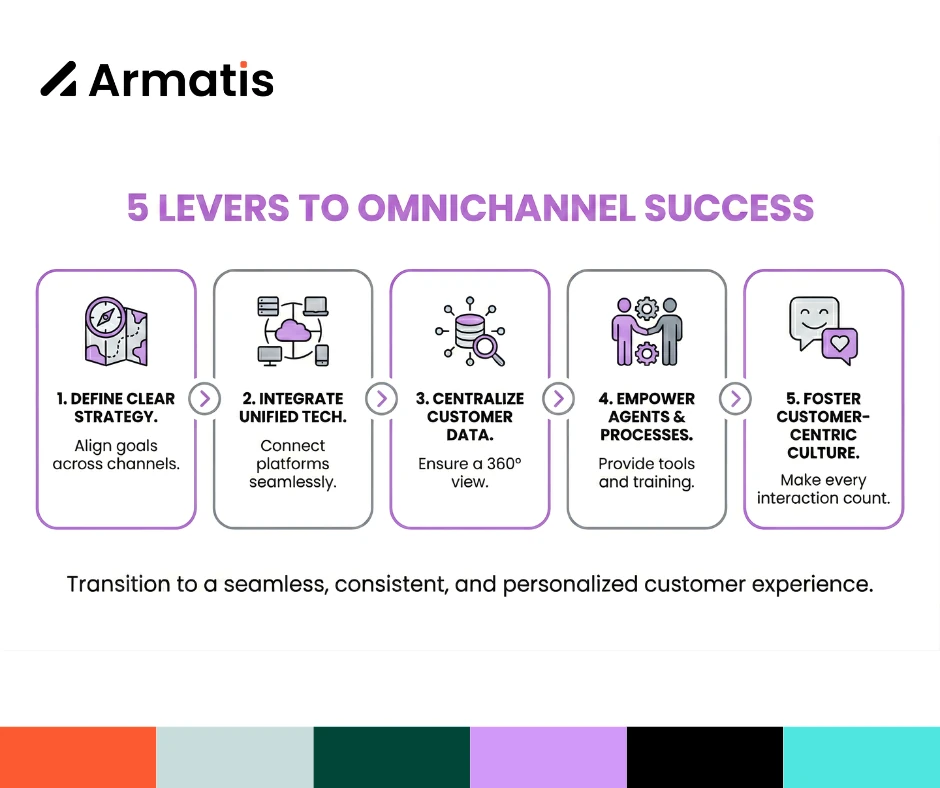
Omnichannel isn’t a mere multichannel evolution. It’s a complete customer relationship overhaul, organized around the customer rather than channels or internal departments.
The five levers form a coherent ecosystem:
Combining these, companies gain operational agility and customer satisfaction simultaneously. Data confirms: successful omnichannel transformations see average 27% client retention improvement, 23% operational cost reduction, 19% customer lifetime value increase.
With the right partner/strategy, transformation shifts from daunting project to true growth/competitive edge lever. Customer relations’ future is omnichannel. Companies mastering transition today build tomorrow’s advantage.
Fill the form below now for the best solution to your project.

An omnichannel strategy integrates/synchronizes all company communication/sales channels for homogeneous/continuous customer experience. Unlike multichannel where channels operate independently, omnichannel unifies data/processes/teams around 360° customer view. Customers switch channels frictionlessly; company recognizes at every touchpoint.
Duration varies by existing ecosystem complexity, channels to integrate, digital maturity.
Key: progressive/structured approach. Start with pilot on 1-2 channels for part of clientele, measure, adjust, scale gradually. Transparent communication with teams/clients on changes. Use “quick wins” methodology: identify fast improvements proving omnichannel value/building buy-in. BPO partner lets you test omnichannel parallel to current ops, minimizing disruption risks.
Specialized BPO offers decisive levers: immediate access to performant tech infrastructure (unified platform, CDP, AI) without heavy investment, expertise from multiple successful transitions, flexibility for peaks/seasonality, multilingual/international coverage boosting growth.
Outsourcing lets internal teams refocus on core business, delegating customer service operational complexity.
AI isn’t strictly mandatory but greatly enhances omnichannel performance/efficiency.
It enables intelligent request routing, auto-interaction summaries, predictive need analysis, large-scale personalization, repetitive task customer relationship automation.
Modern solutions like Armatis’ SquAire suite integrate AI to boost advisor capabilities while preserving human relation aspect.
This article draws from reliable sector research/analyses:



Discover how we can optimise your strategy with an
innovative, tailor-made model

Join the leaders who trust our multilingual and technological expertise.