


Your CSAT score is stuck at 65% while your competitors proudly display 80%? You’re not alone. Thousands of companies hit the same ceiling, convinced that boosting customer satisfaction takes months of transformation and a huge budget.
The truth? It doesn’t. I’ve helped dozens of teams increase their CSAT by 15 to 20 points in just a few weeks simply by pulling the right levers at the right time.
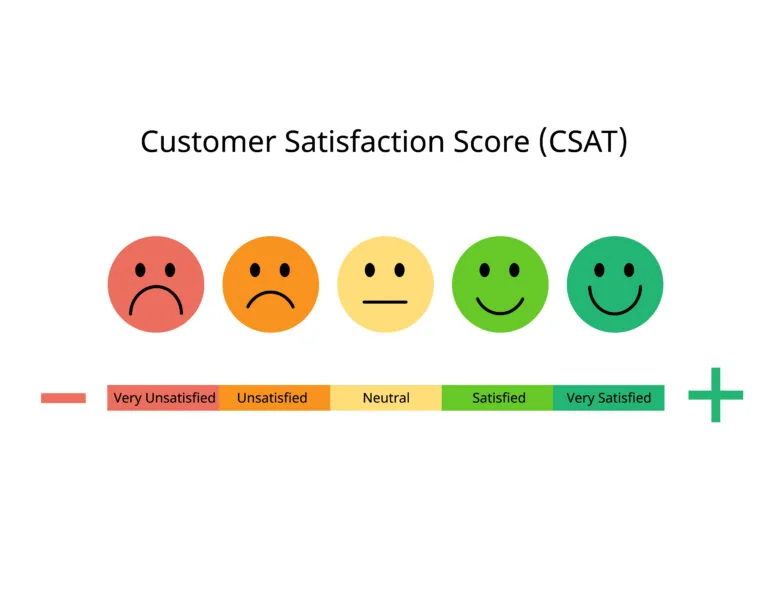
The Customer Satisfaction Score (CSAT) measures how satisfied customers feel right after a specific interaction. Unlike NPS, which gauges long‑term loyalty, CSAT captures emotion in the moment that instant when a customer has just closed a ticket, hung up the phone, or received an order.
A high CSAT isn’t just a vanity metric. Industry data shows that every point gained above 75% correlates with a 3–5% increase in customer retention. For a SaaS company generating €1M in annual recurring revenue, that’s €30K–€50K preserved.
But before jumping into action, ask yourself : are you measuring your CSAT correctly?
CSAT is only reliable if you measure it at the right time — and that’s precisely where most companies fail.
According to Qualtrics XM Institute 2025 benchmarks:
62% of surveys sent too early (<1 h) inflate scores artificially (+12 pts).
48% of surveys sent after 48 h see response rates collapse by 35%.
In short: too early = biased data. Too late = no data.
Timing accounts for 50% of your CSAT quality.
| Interaction Type | Optimal Timing | Average Response Rate |
|---|---|---|
| Phone/chat support | 5–30 min after resolution | 87% |
| Email/ticket support | 2 h after closure | 72% |
| E‑commerce delivery | 24–48 h after receipt | 65% |
| SaaS onboarding | +7 days (after first value) | 58% |
Why it works: customers still remember the experience but have enough distance to give an honest answer.
A simple timing adjustment can increase your CSAT by up to +8 points (SuperOffice Benchmark 2025).
Every minute counts. 46% of customers expect a reply within four hours — yet 62% of companies never respond at all.
Action: set up an intelligent auto‑reply that does more than say “We’ve received your message.” Include useful links (FAQ, hotline, estimated response time) relevant to the request type.
Expected impact: +5 to 8 CSAT points simply by reassuring customers that someone is on it.
Over‑scripted agents kill authenticity. Replace word‑for‑word scripts with flexible resolution frameworks. Train agents in tactical empathy showing understanding, offering options, and adapting tone to context.
Practical tip: run a one‑hour workshop where agents share their best connection phrases and de‑escalation techniques. Turn it into a living playbook for all.
Few things frustrate customers more than repeating their problem three times. Each transfer can cost 10–15 CSAT points.
Solution: implement shared internal notes instantly visible to any agent. In omnichannel environments, the goal isn’t to avoid transfers, but to make them invisible to the customer with synchronized context across phone, email, chat, and social media.
Impact: customers feel understood before they even speak.
Great service depends on empowered people, not endless approvals.
Define clear autonomy thresholds:
Result: faster resolutions, smoother workflows, higher satisfaction.
Uncertainty kills satisfaction. Display clear ticket statuses (“Received,” “Under analysis,” “Solution identified,” “Resolved”) and attach every update to a meaningful explanation (e.g., “Our tech team identified the issue and is testing a fix. Expect an update by 4 PM today.”).
Transparency builds trust, and trust drives CSAT.
The best service teams solve problems before they exist. Analyze recurring tickets and set proactive touchpoints.
Result: 20–30% fewer tickets and major CSAT gains through proactive care.
Using a customer’s name is table stakes. Real personalization adapts to their journey, maturity, and context.
Goal: respond as if you truly know them, making each interaction faster, easier, and more relevant.
Don’t just solve issues, confirm success.
Send a follow‑up 48 h after closure:
“We marked your request as resolved two days ago, is everything working fine now?”
This small act can add 10–15 CSAT points by showing genuine care.
Every low CSAT (<3/5) is an opportunity.
Set up an automated alert for any score ≤2/5 a manager must contact the customer within four hours. Not to justify, but to understand and fix.
Aggregate this data weekly to identify your top three recurring pain points, then dedicate one monthly session to solving them structurally.
A single global CSAT hides more than it reveals. Break it down by: channel, request type, agent, time window, and resolution duration.
Build a simple dashboard with five metrics: overall CSAT, first response time, first contact resolution rate, average number of transfers, and CSAT by channel. Share it weekly with the whole team to build a culture of continuous improvement.
You now have ten actionable levers but doing all at once means doing none well.
Next 30 days plan:
Plan transfer reduction (Lever 3) and deep personalization (Lever 7) for months 2–3.
Never optimize for the metric over true satisfaction.
Inflating scores by sending surveys only to happy customers is a short‑term illusion.
Your goal isn’t a nice dashboard, it’s customers so happy they stay, buy more, and recommend you.
Record today’s CSAT, first response time, and first‑contact resolution rate. Re‑evaluate after 30 days:
Improving CSAT is a marathon, not a sprint. These ten levers are your starter kit. Once your foundations are solid, explore advanced tactics like AI‑based dissatisfaction prediction, gamification, or semantic analysis of feedback.
For now, focus on what matters most: respond faster, better, with more empathy and transparency.
Your CSAT in 30 days will thank you.




Join the leaders who trust our multilingual and technological expertise.