

Since 11 August 2026, unsolicited telephone marketing has been banned in France.
The Cazenave Act (No. 2025-594 of 30 June 2025) shifts the country from an ‘opt-out’ system (Bloctel) to a system of explicit prior consent. Any business that calls a private individual without proof of consent is liable to a fine of up to €375,000 per call for a legal entity (Article L. 242-16 of the Consumer Code).
For sales, marketing and CX departments, the issue goes beyond compliance: it is the entire volume-based acquisition model that is becoming obsolete.
In brief
- Key date: Enters into force on 11 August 2026.
- General rule: B2C telemarketing is subject to prior, explicit and verifiable opt-in. Bloctel is no longer applicable to commercial prospecting.
- Exceptions: B2B remains outside the scope of the reform. Existing customers may still be contacted within the framework of the contractual relationship (upselling, cross-selling).
- Strict prohibitions: Energy-efficiency refurbishments, the CPF and home adaptations remain subject to a ban on cold calling, even with the customer’s consent.
- Financial penalties: Up to €75,000 per appeal for an individual and €375,000 for a legal entity.
- New strategy: The focus is no longer on calling more prospects, but on making better use of the consents obtained.
- Opportunity: Companies that invest in generating qualified leads and personalising customer journeys will be best placed.
1. What Bloctel has never managed to rectify
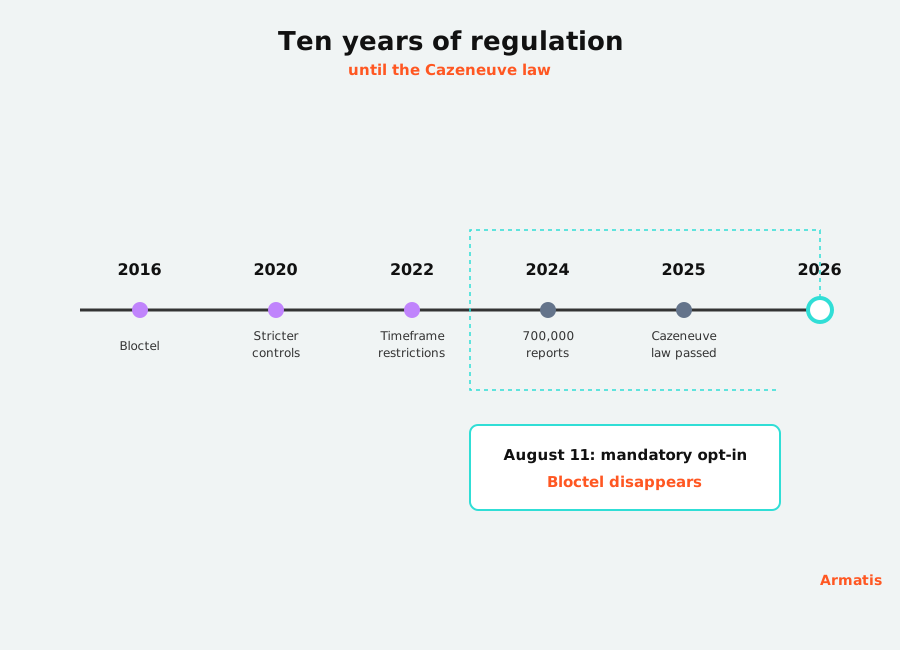
Introduced in 2016, the Bloctel register was designed to give consumers back control over cold calling. Since then, a number of measures have been introduced to strengthen the regulation of the sector: a requirement to regularly purge marketing databases, restrictions on the days and times when calls may be made, limits on the number of permitted marketing calls, and tighter controls.
Yet, despite this regulatory framework, cold calling remains one of the main sources of consumer dissatisfaction. In 2024, the DGCCRF recorded nearly 700,000 reports relating to cold-calling practices via the SignalConso platform – an unprecedented figure that highlights the limitations of the system.
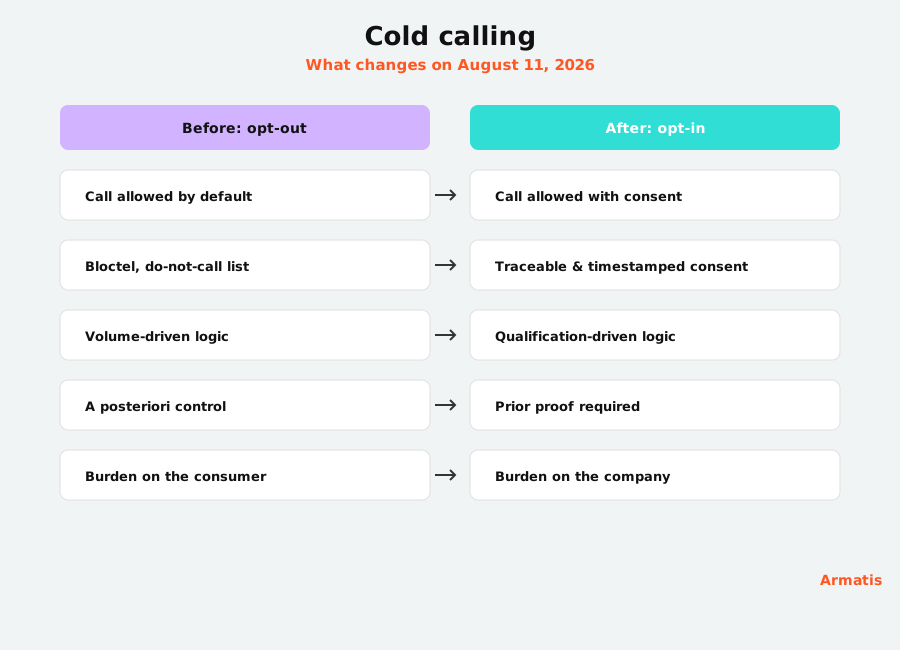
This situation highlights a structural weakness in the so-called ‘opt-out’ model. As long as the principle remains that of consent by default, businesses retain a sufficiently large pool of potential customers to make their campaigns profitable, even after excluding those registered with Bloctel. In practice, the right to object has often resulted in an additional administrative burden rather than a genuine reduction in marketing pressure.
The Cazenave Act completely reverses this approach. From 11 August 2026, it will no longer be up to the consumer to indicate that they do not wish to be contacted. It is now up to the company to demonstrate that it has obtained, prior to any call, prior, explicit and verifiable consent.
This change may seem straightforward on paper, but it brings about a profound shift in commercial practices. The consumer’s consent must be verifiable by means of traceable evidence, such as a recording, a time-stamped confirmation or evidence stored in the company’s information system. It must also be obtained in a clear manner, specifying the identity of the organisation making the calls and the purpose of the solicitation.
In other words, the volume-based approach is giving way to a permission-based approach. The new regulations, however, distinguish between several different situations:
1.a Total ban
In certain sectors considered particularly sensitive – notably energy-efficiency refurbishment, the CPF (Personal Training Account) and the adaptation of homes for people with reduced mobility – cold calling remains prohibited, even where prior consent has been given.
1.b General opt-in scheme
In most sectors, telephone canvassing remains permitted, but only where the company can demonstrate that it has valid consent from the prospect. In the absence of such proof, each call may constitute an offence.
This development therefore does not merely change the rules governing cold calling. It redefines the way in which businesses approach customer acquisition, obtain consent and maintain relationships with their prospective customers.
2. The volume model was already at the end of its life cycle
The coming into force of the Cazenave Act is accelerating a transformation that had already begun. Long before the introduction of the universal opt-in system, the mass marketing model was showing signs of running out of steam.
For several years now, businesses have been observing a gradual decline in the effectiveness of unqualified outbound calling campaigns. Conversion rates remain low, answer rates are falling and the number of attempts required to reach a prospect continues to rise. The more consumers are approached, the more they develop defence mechanisms.
The problem is not just a commercial one. It is behavioural. When a consumer receives a call from an unknown number, trust is no longer taken for granted. It has to be earned. The interaction often begins with a degree of mistrust, which automatically reduces the chances of having a meaningful conversation, even when the offer is relevant.
This trend comes at a direct cost. Every attempt to make a call ties up staff resources, technological tools and production time. But it also generates a cost that is more difficult to measure: the impact on brand image. A company may secure a few sales in the short term whilst gradually damaging the perception that thousands of consumers have of it.
The figures illustrate this reality. According to a UFC-Que Choisir survey published in 2024, 97 per cent of French people say they are annoyed by unsolicited sales calls. According to Arcep (the ‘J’alerte l’Arcep’ report, 2025), the number of complaints received regarding unsolicited or abusive calls and messages rose by 113 per cent between 2024 and 2025. When a channel is rejected by such a large majority of the population, the issue is no longer merely a regulatory one. It becomes a strategic one.
Many sectors, such as energy, telecommunications, insurance and home care services, are now faced with this dilemma: continuing to invest in a strategy whose effectiveness is waning, whilst at the same time having to contend with growing consumer mistrust.
In this context, the Cazenave Act does not mark a break with the past. It formalises a process that is already underway. It transforms a fundamental trend into a regulatory requirement and encourages businesses to shift from a volume-based approach to one based on consent, qualification and relevance.
3. The economic rationale for consent
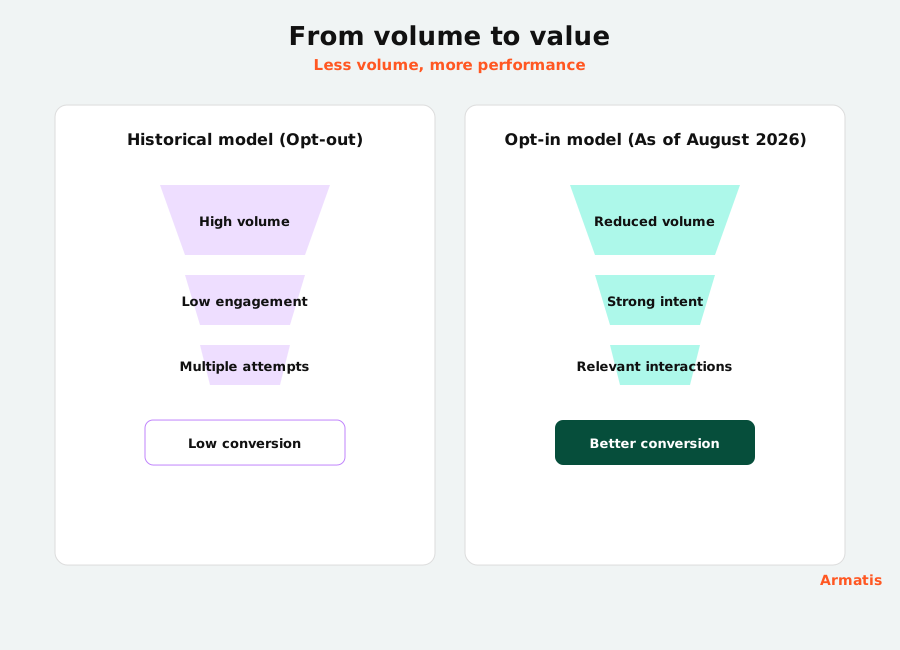
At first glance, the opt-in system seems like a constraint: fewer contacts, lower volume, fewer opportunities. In reality, it forces companies to focus on what really matters: the quality of leads.
A prospect who agrees to be contacted is not like other prospects. They have taken a deliberate step, whilst seeking information, comparing offers or considering a purchase. When they pick up the phone, the conversation no longer begins with mistrust but with interest.
This difference fundamentally changes the economics of lead generation. Interactions are more relevant, conversion rates are higher and conversion times are often shorter. Conversely, the hidden costs of mass cold calling become more apparent: an increase in the number of call attempts, low engagement from prospects, damage to brand image and the acquisition of customers with low loyalty.
In other words, the opt-in approach reduces the volume of leads but increases the potential value of each lead.
4. Insurance, energy, telecoms: the sectors most at risk
All organisations involved in telemarketing are affected by the reform, but some sectors will need to make more far-reaching changes to their customer acquisition models.
The insurance, energy, telecommunications and home services sectors have traditionally relied on large-scale outbound calling campaigns. For these organisations, the switch to an opt-in model represents much more than a regulatory change: it alters the very mechanisms by which leads are generated.
However, the law maintains an important distinction between cold calling and customer relations. A company retains the right to contact an existing customer as part of an ongoing business relationship, in particular to propose a complementary offer or to amend an existing contract.
What is no longer permitted, however, is the ability to freely approach prospective customers who have never expressed a wish to be contacted.
For certain sectors already subject to specific bans, such as energy-efficient refurbishment, the CPF or certain activities relating to home adaptations, the restrictions remain even stricter.
5. B2B remains permitted, but the context is changing
The Cazenave Act relates to cold calling of private individuals. B2B cold calling by telephone therefore remains permitted under the existing regulatory framework.
However, businesses would be wrong to conclude that nothing is changing. Business decision-makers operate in the same environment as consumers. Their tolerance for unsolicited communications is also declining, whilst their expectations regarding personalisation and relevance are rising.
The question, therefore, is no longer simply what is legal, but what is effective. Even in B2B, the underlying trend is driving organisations towards approaches that are more targeted, better contextualised and more closely aligned with the prospect’s genuine interests.
6. Shaping the future: building consensus before putting it into practice
The challenge in the coming years will not be to find an alternative to mass marketing. It will be to develop systems capable of generating qualified and traceable consent.
An opt-in is the result of a journey. It stems from useful content, a clear offer, a request for information or an interaction that creates enough value for a prospect to agree to be contacted.
The companies that will emerge stronger from this transition are generally those that are already investing in three complementary areas:
6.a Generating leads with purchase intent
Landing pages, simulators, expert content, requests for demonstrations and contact forms enable you to capture leads who have expressed a genuine need, whilst documenting their consent.
6.b Smart use of data
Analysing digital behaviour helps to identify the right time to make contact and to prioritise the prospects most likely to convert.
6.c Developing the skills of the sales teams
When volume decreases and the value of each contact increases, the quality of the interaction becomes crucial. Skills such as listening, advising and personalisation become more important than following a standardised script.
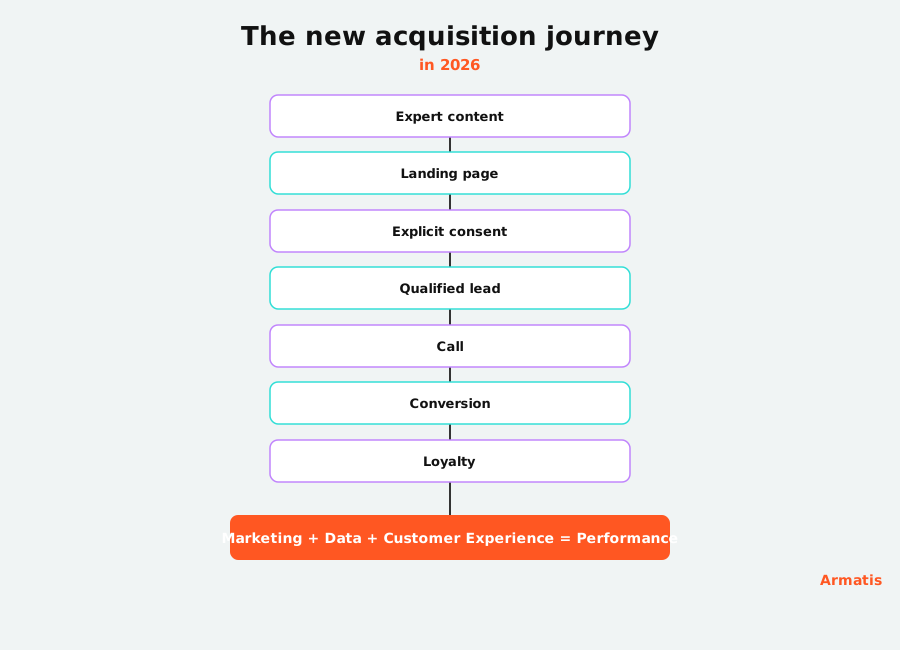
7. What this Act says about customer relations in 2026
It would be tempting to view the Cazenave Act as merely a regulatory constraint. In reality, it formalises a shift that is already underway in consumer behaviour.
For several years now, members of the public have been developing their own ways of protecting themselves against unwanted solicitations: filtering calls, blocking unknown numbers, putting callers on silent, and reporting abusive practices. The law does not create this mistrust. It simply acknowledges a reality: attention has become a scarce resource.
In this context, securing a few minutes’ conversation with a prospect can no longer be taken for granted. You now have to earn it. The telephone remains invaluable for complex sales, high-stakes decisions or situations requiring explanation and reassurance. But it is no longer a channel for mass prospecting. It is becoming a channel for engagement.
This is precisely what the opt-in approach is all about: the ‘appointment’ approach replaces the ‘interruption’ approach. When a prospect agrees to be contacted, the conversation begins in a radically different atmosphere. The aim is no longer to capture their attention, but to respond to it.
8. The role of outsourcing providers in this transformation
This development is also changing expectations of customer relationship partners.
In the future, performance will no longer be measured solely by the ability to handle a large number of calls. It will depend on the ability to capitalise on consented leads, ensure compliance processes, personalise interactions and generate greater value from every contact.
For outsourcing providers, this means managing the entire value chain: managing and tracking consent, integrating with CRM and marketing tools, qualifying and enriching leads, training advisers to adopt a more consultative approach, and monitoring performance against business and CX metrics.
KPIs are also evolving. Call volume and answer rates are gradually being replaced by indicators such as the conversion rate of qualified leads, customer satisfaction following an interaction, the value generated per contact, and the loyalty and retention of existing customers.
When every conversation counts for more, the quality of the exchange becomes the key driver of performance.
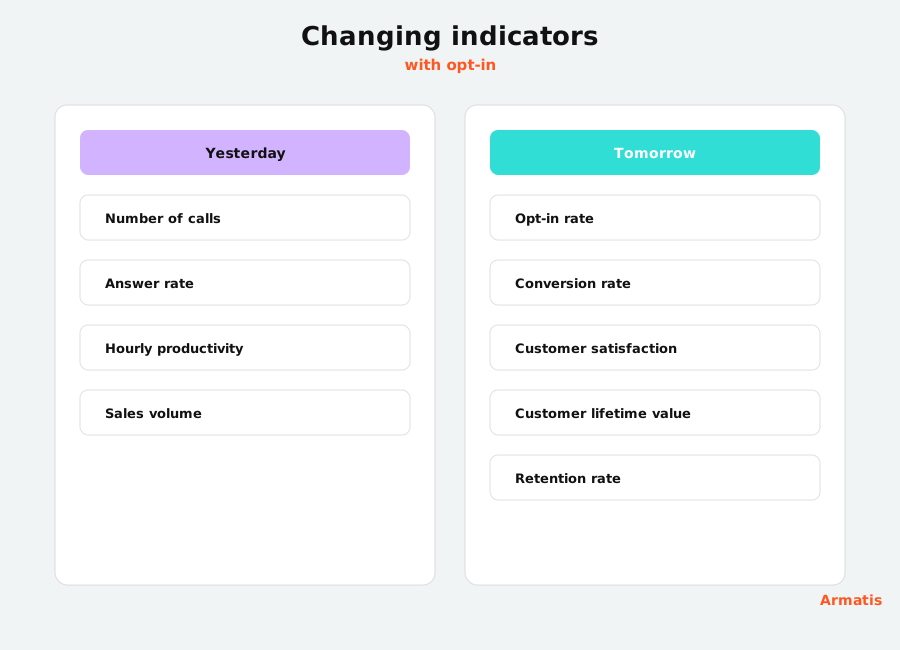
9. Conclusion: a constraint that drives the market towards greater value
11 August 2026 does not mark the end of cold calling. It marks the end of a model based on volume and implied consent.
The telephone remains one of the most effective channels for supporting complex purchasing decisions, answering questions, reassuring customers or closing a sale. What has changed is where the relationship begins.
With the opt-in approach, consent is no longer merely a legal formality, but an indicator of commercial quality.
The companies that will succeed in this transition will not be those that seek to replicate yesterday’s practices within a new regulatory framework. They will be those that are able to create customer journeys capable of building trust even before the first call is made.
To support this transition at an operational level – from generating qualified leads to managing specialist call centres – the Armatis teams work with their clients across the entire value chain. Get in touch with our teams to develop your transformation plan.
Box: What the law says
Date of entry into force: 11 August 2026 (Act No. 2025-594 of 30 June 2025 on combating fraud in relation to public aid, Article 13).
Principle: B2C cold calling is prohibited as a matter of principle. It is permitted only if the consumer has given prior, free, explicit and verifiable consent. The system is switching from an opt-out regime (Bloctel) to an opt-in regime.
Permitted cases: Cold calling remains permitted in the context of an existing contract, for offers directly related to that contract. Certain forms of contact (surveys, public services, debt collection) do not constitute commercial cold calling. B2B is not directly covered.
Specific sectors: Cold calling is prohibited in certain sectors (energy-efficient refurbishment, the CPF, home adaptations), unless there is an existing contractual relationship.
Penalties: failure to comply with the regulations governing door-to-door selling is punishable by an administrative fine of up to €75,000 per call for a natural person and €375,000 per call for a legal person (Article L. 242-16 of the Consumer Code, source: economie.gouv.fr). In the event of a clear case of exploitation of vulnerability in connection with door-to-door selling, the penalties are more severe: a fine of up to €500,000 and five years’ imprisonment; this is a separate regime and should not be confused with the standard penalty for unsolicited canvassing.
Evidence of consent: The organisation must be able to demonstrate that consent was given (time-stamped record, source, channel). Voice recording is good practice but is not compulsory.
Frequently asked questions about the 2026 opt-in law
Does the 2026 opt-in law also apply to B2B?
No. The Cazenave Act (No. 2025-594 of 30 June 2025) does not alter the legal framework governing business-to-business (B2B) telemarketing. B2B marketing remains governed by the GDPR and existing practices. Only marketing to private individuals (B2C) will switch to a mandatory opt-in system from 11 August 2026.
Can an existing customer still be contacted without their consent?
Yes, within a specific scope. Calls relating to a current contract, as part of an up-sell or cross-sell directly linked to the subject matter of the contract, are permitted without the need for further consent, unless the customer objects. This exception applies in particular to telecoms operators and energy suppliers who manage an active customer base.
What constitutes valid consent under the Cazenave Act?
Consent must be explicit, given in advance and traceable. A tick box on a form is not sufficient if it does not clearly state the identity of the caller and the purpose of the forthcoming call. An audio recording of a time-stamped verbal opt-in or a record in a certified consent management tool are the forms of evidence required by the DGCCRF.
What is the actual risk for a company that fails to comply with the opt-in requirement?
Administrative fines amount to 75,000 euros per call for a natural person and 375,000 euros per call for a legal person (Article L. 242-16 of the Consumer Code). The DGCCRF has enhanced enforcement powers. Penalties apply for each established infringement, which makes structural non-compliance particularly costly.
How can you generate high-quality opt-in leads to feed into call centres?
The key strategies are inbound marketing (value-added content, simulators, contact forms with explicit opt-in), generating leads from prospects with clear intent via certified partners, and re-qualifying the existing customer base through multi-channel consent collection campaigns. Behavioural scoring then enables calls to be prioritised at the moment when the intention to purchase is at its strongest.
Sources
- Act No. 2025-594 of 30 June 2025 on combating fraud involving public aid, Article 13 (known as the Cazenave Act) — Légifrance
- Consumer Code, Article L. 242-16 (penalties) — Légifrance
- DGCCRF / economie.gouv.fr — ‘The rules on telemarketing that businesses must follow’
- DGCCRF — Summary of reports relating to illegal door-to-door selling via SignalConso, 2024
- UFC-Que Choisir — Survey on cold calling, October 2024
- Arcep — ‘I’m reporting this to Arcep’ review, 2025