


From simple multichannel presence to a unified customer experience: key steps to connect your channels, engage your teams, and drive performance.
At first glance, multichannel might look like a success story your customers can reach you everywhere (phone, email, chat, social media), your teams respond quickly, and your tech stack seems solid. But behind this smooth façade, data often sits in silos and interactions remain disconnected. The result? A fragmented and frustrating customer experience where clients must repeat their story at every touchpoint. For businesses, that means inefficiency and declining customer loyalty.
For Customer Experience, Marketing, and Digital Transformation leaders, the challenge today isn’t to “be everywhere,” but to intelligently connect every channel. Omnichannel isn’t just another tech project, it’s a strategic driver that unifies data, personalizes interactions, and boosts engagement, performance, and growth.
So, how do you move from multichannel operations to a seamless, profitable omnichannel strategy?
Here are six essential steps to create a connected experience and turn your customer service into a growth engine.
Today’s customers expect continuity. They might open a request through a chatbot, follow up via email, and expect the phone agent to already know their full history without explaining it again.
Omnichannel service is no longer optional; it’s a cornerstone of customer success. Lack of consistency across channels is one of the biggest drivers of frustration.
Companies with strong omnichannel strategies achieve customer retention rates of 89%, compared with only 33% for those with weak omnichannel engagement (Source: Aberdeen Group). Omnichannel isn’t a cost center, it’s a loyalty accelerator.
List every channel you offer—phone, email, chat, social media, messaging apps, apps. Most brands manage around five service channels, but more isn’t always better. Adding unconnected channels usually creates new problems instead of solving old ones.
Ask yourself:
This is where most organizations struggle. Do your sales, marketing, and service teams share one customer view? Do your systems talk to each other—or operate as standalone blocks?
Warning signs:
Look at your own processes through the eyes of your customer. Test your own support journeys, analyze Voice of the Customer (VoC) data, and note recurring pain points like “I had to explain my issue three times” or “No one could see my previous request.”
The goal isn’t to multiply tools, it’s to simplify the journey. Stop thinking in “channels” (internal view) and start thinking in “life moments” (customer view).
Align every interaction with the stages of the customer lifecycle: research, purchase, onboarding, support, retention. The key question: how can customers switch channels effortlessly without losing context?
Example: if a customer checks your FAQ for a technical issue, then opens a chat, the agent should immediately know which article was read and offer relevant assistance—without asking the client to start over.
Data shouldn’t be static, it should be predictive. Detect early signals that a client might need help, then offer proactive support.
Journey mapping is essential to visualize friction points and design unified target flows. It’s also a collaborative tool that aligns teams across departments on one shared vision.
Technology is a means, not the goal. The biggest mistake organizations make is “tool stacking” – adding more systems that don’t integrate and end up creating new silos.
The ideal setup is a Contact Center as a Service (CCaaS) solution that brings together every interaction—voice, chat, messaging, social, email—within a single agent interface.
At Armatis, for instance, we use SquAire Interaction, our omnichannel platform powered by AI and process orchestration. It provides agents with a real‑time 360° view of the customer and AI‑driven decision support tools.
Integrating your contact platform with your CRM is non‑negotiable. It ensures every interaction builds on a unified and updated customer history. Businesses with a unified view of each customer typically increase revenue by up to 20%.
Select technologies with robust APIs that easily integrate with your ecosystem (ERP, BI, business tools) instead of closed systems. Flexibility and interoperability are essential in a constantly evolving environment.
AI is transforming customer service—but it must empower humans, not replace them. At Armatis, our SquAire suite includes AI assistants, automated summaries, smart knowledge bases, and voice bots that enhance human performance.
Nearly 89% of companies leveraging AI for omnichannel report higher customer satisfaction. Used well, AI is a productivity accelerator that lets human agents focus on high‑value interactions.
Transformation is above all a human project. The best technology fails without engaged, well‑trained teams.
Today’s agents must be versatile—comfortable with both written and spoken interactions, able to manage multiple conversations simultaneously, and skilled at using data to personalize responses.
Tomorrow’s advisors aren’t script executors; they’re customer relationship experts assisted by AI to be faster and more relevant. In 2024, 83% of companies invested in omnichannel training for service teams.
Omnichannel success requires close collaboration between marketing (engagement), sales (conversion), and service (retention). Shared KPIs, data transparency, and cross‑department rituals—like weekly syncs or common dashboards—are key.
Encourage First Contact Resolution (FCR) and give agents the autonomy to solve issues regardless of the entry point. Empowered teams are more engaged, confident, and deliver better outcomes.
Omnichannel is not a one‑time project—it’s a continuous improvement process driven by data.
Modernize your KPIs
Go beyond isolated metrics like average handling time. Focus on holistic indicators that reflect the end‑to‑end experience:
Use feedback loops
Analyze customer verbatims, channel‑switching behaviors, and abandonment rates to identify weak spots. Adjust training, processes, or tools accordingly. Advanced analytics can detect early warning signs and predict issues before they escalate.
Adopt an agile mindset
Continuous improvement requires short test‑and‑learn cycles:
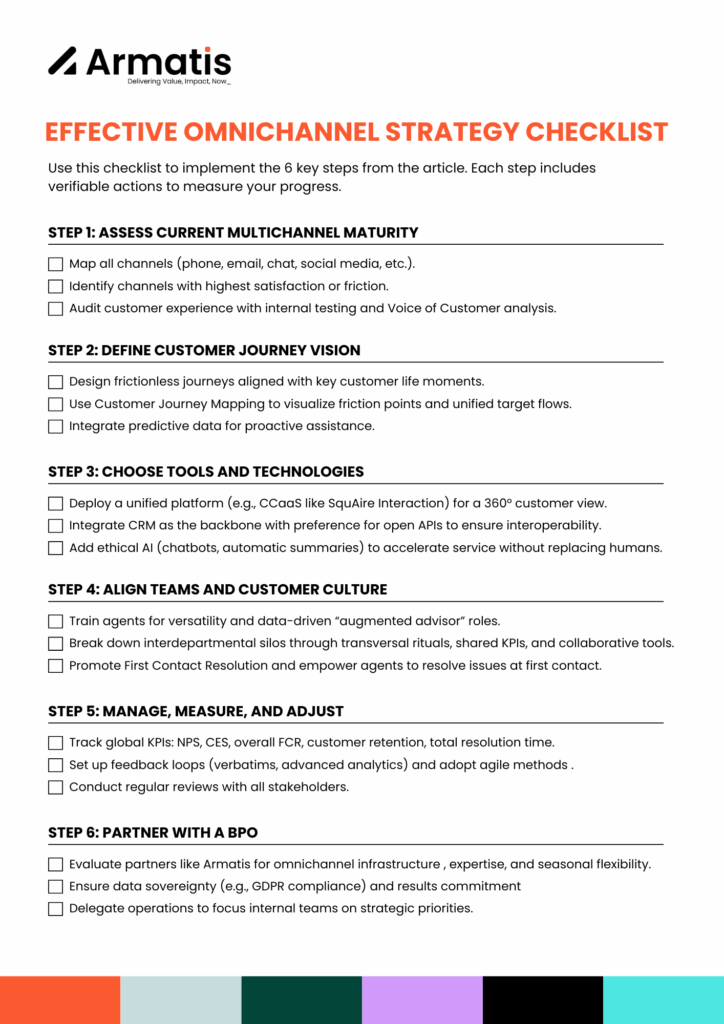
Building an effective omnichannel strategy demands time, tech resources, and deep expertise. Doing it all in‑house can quickly become expensive and slow.
Partnering with a BPO (Business Process Outsourcing) expert isn’t just outsourcing—it’s a strategic accelerator for customer experience transformation.
The Armatis approach: technology, expertise, agility
Integrated and sovereign technology
Our clients benefit from a full omnichannel infrastructure—voice, chat, social, email, messaging—powered by AI and real‑time analytics.
The SquAire suite includes:
SquAire Interaction – omnichannel contact platform with AI and process orchestration
SquAire Quality – multilingual quality monitoring and insight management
SquAire Knowledge – knowledge orchestration for agents and supervisors
SquAire Automation – automation for actions and conversations
All hosted in Europe for GDPR compliance and data sovereignty.
Proven operational expertise
With 40+ years of experience, 10,000 employees across 23 sites in 5 countries, and more than 300 clients in banking, utilities, retail, transport, and public services, Armatis designs and operates customer interactions that truly deliver measurable results.
For a leading energy provider, our approach enabled 72% digital interactions and a successful RPA deployment.
Flexibility and business focus
By delegating operations to Armatis, brands gain agility.
We handle seasonal peaks (for example: managing over 4 million multilingual contacts per year for Ryanair in Poland), adapt resources in real time, and free internal teams to focus on strategy, innovation, and customer value.
A high‑performing omnichannel strategy rests on six pillars:
Think journeys, not channels.
Omnichannel platform + CRM + open APIs.
Anticipate, personalize, improve.
Empowered teams and cross‑functional collaboration.
End‑to‑end KPIs, continuous improvement, agility.
To accelerate transformation securely.
Omnichannel isn’t an IT initiative, it’s an organizational evolution. By following these six steps and choosing the right partner, you can turn your customer service into a true growth driver and loyalty builder.
In France, 96% of consumers still expect to reach brands by phone—but they also demand consistency across every touchpoint. Omnichannel is how you deliver on that promise.
Fill out the form below now so that we can design the best solution for your project.

It is an approach that unifies all communication channels (both physical and digital) to ensure a consistent, seamless, and uninterrupted customer experience. The customer’s history and context are shared across all touchpoints, so the client never has to repeat their story.
The ideal solution is a unified contact platform (CCaaS) that integrates natively with your CRM. It should centralize all interactions—voice, email, chat, social media—and provide the agent with a real-time 360° customer view.
For example, Armatis offers SquAire Interaction, a platform designed for such integrated omnichannel support.
Outsourcing accelerates transformation by providing ready-to-use technology, industry expertise to optimize processes and train teams, and the flexibility to quickly adapt resources. This ensures a faster, more cost-effective deployment and smoother scaling.



Contact our teams to discuss your challenges and find out how we can support you in your transformation.

Join the leaders who trust our multilingual and technological expertise.