


Imagine this now-common scenario: a customer contacts you via Instagram in the morning with a product question, continues the conversation via live chat on your website at noon, then finalizes their request by phone in the evening. At every step, they expect to be recognized, understood, and supported as if the conversation had never been interrupted.
This is precisely the promise of omnichannel customer service: delivering a fluid, consistent, and personalized experience across every touchpoint—without friction or unnecessary repetition. From the customer’s perspective, there is only one continuous conversation with your brand, even if it unfolds across multiple channels and over several days.
Before exploring omnichannel customer service, let’s clarify a few key concepts:
These terms are often confused, yet they represent three distinct levels of customer relationship maturity.
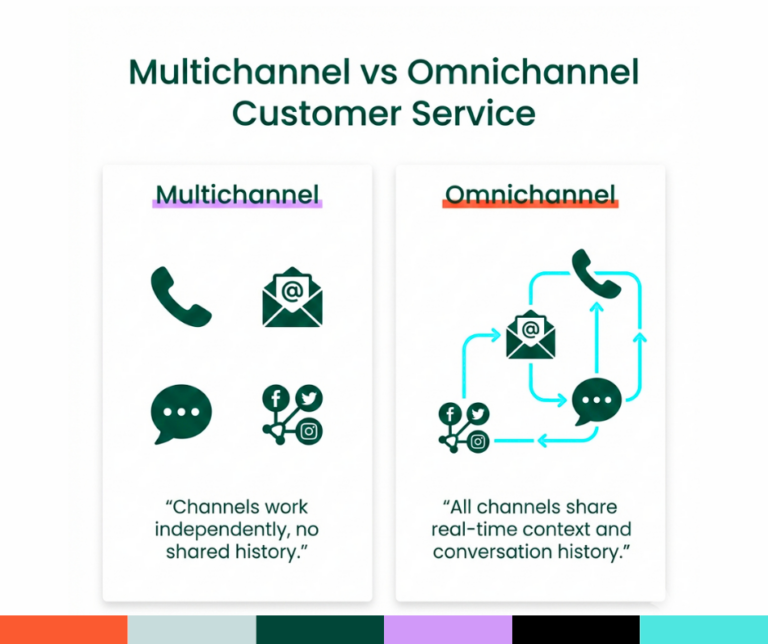
The company offers multiple channels—phone, email, chat, social media—but they operate in silos. No information is shared between channels. A customer who emails and then calls must repeat their entire request. Each channel ignores what happened on the others.
Channels begin to communicate. For example, a chatbot identifies a request requiring a human advisor and transfers it to a phone agent with some contextual information. Coordination exists, but remains incomplete. Silos persist between teams, tools, and processes.
All channels are interconnected and share the customer’s full interaction history in real time. Every interaction feeds a unified, instantly accessible view. Customers never need to repeat themselves—regardless of channel or advisor. The company speaks with one consistent, informed voice.
Omnichannel breaks down barriers between tools, teams, and channels to create a truly continuous customer journey.
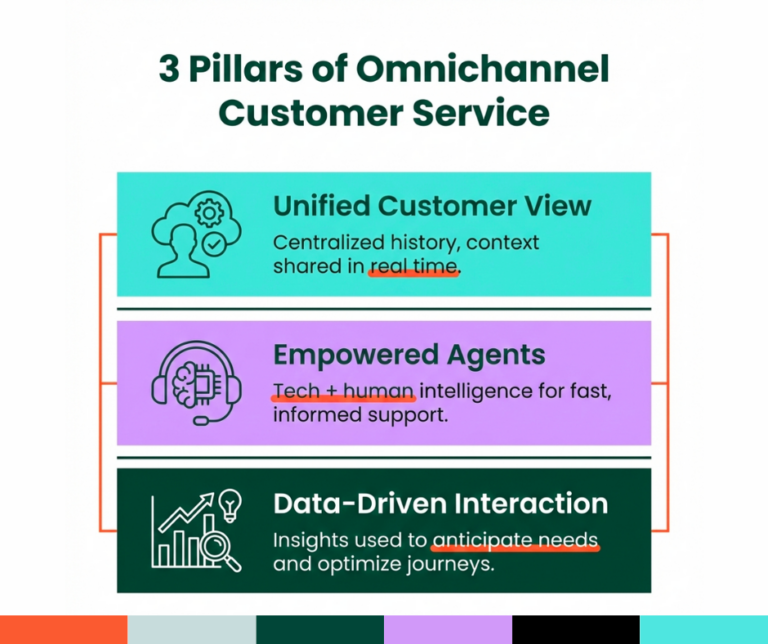
Deploying omnichannel customer service goes far beyond adding a chatbot or a new messaging channel. It requires a deep transformation built on three core pillars.
All interactions, across all channels, are centralized in a unified, real-time history. Advisors instantly access full context: past requests, expressed preferences, purchase history, and previous resolution attempts. This eliminates frustrating redundancies and significantly accelerates resolution.
In practice, when a customer calls after chatting online, the advisor immediately sees the previous exchange and continues seamlessly—without asking, “Can you remind me of your request?”
Equipped with intelligent tools, advisors move effortlessly between channels while retaining all necessary information. They no longer manage isolated “tickets” but nurture ongoing customer relationships. AI supports repetitive tasks (categorization, information retrieval, automatic summaries), allowing advisors to focus their energy and empathy on high-value situations.
This approach transforms the advisor’s role: from process executor to true brand ambassador, capable of anticipating needs and creating relational value.
Every interaction becomes actionable data. Companies can analyze real customer journeys, identify recurring friction points, anticipate needs before they are expressed, and continuously optimize their customer service setup. This data-driven approach enriches customer knowledge and refines relationship strategies over time.
Customer journeys have changed dramatically. They are no longer linear but zigzag across channels depending on time, context, and urgency. A customer might discover a product on Instagram, read reviews on your website, ask a question via chat, place an order on mobile, then call customer service for a modification—all in the same day.
Customers now expect consistency and responsiveness everywhere, at all times. They do not distinguish between channels; for them, there is only one company that must recognize them instantly.
In this accelerated digital world, human connection remains the anchor. Technology does not replace relationships—it strengthens them by giving teams the tools to better understand, anticipate, and serve customers.
A well-orchestrated omnichannel strategy delivers tangible performance gains:
Companies outsourcing customer service increasingly seek partners capable of managing end-to-end omnichannel experiences, not just handling volumes on isolated channels.
The challenge is no longer to open more channels—but to connect them intelligently to deliver a seamless experience. This is where outsourcing partners create real value: rapidly deploying mature technology stacks, mobilizing teams trained in modern customer journeys, and ensuring flexible scalability to handle peaks and seasonality.
Outsourcing provides access to dedicated expertise, advanced technologies (AI, advanced analytics, intelligent routing), multilingual and multi-geographic coverage—while freeing internal teams to focus on core business priorities.
At Armatis, we support this transformation through centralized orchestration of all contact channels: phone, email, chat, social media, and instant messaging. Our approach relies on a unified platform that ensures continuity regardless of how customer journeys evolve. We combine advanced technologies—particularly our SquAire AI agent suite supporting advisors—sector expertise, and an agile operational model to deliver maximum performance and service quality.
Our teams, based across multiple locations and trained in sector-specific challenges, become true ambassadors of your brand. We don’t just manage contacts—we create memorable experiences and strengthen customer loyalty.
Omnichannel customer service is far more than a technological evolution. It represents a new way of designing customer relationships: being present on all relevant channels while preserving the continuity and memory of every interaction.
Companies that succeed in this transformation achieve measurable gains in customer satisfaction, operational efficiency, and service quality. More importantly, they deliver an experience aligned with modern expectations: fluid, personalized, consistent, and deeply human, thanks to technology, not despite it.
Omnichannel is no longer a competitive advantage. It has become a customer expectation. Companies that delay this transition risk losing customers to competitors who already deliver the seamless experience customers demand.




Join the leaders who trust our multilingual and technological expertise.