


A dissatisfied customer no longer keeps frustration to themselves. They share it with thousands of people in a few clicks. Customers now expect quality standards similar to those found in healthcare, where transparent communication and empathy have become the norm.
Unlike other indicators that evaluate overall loyalty, CSAT focuses on immediate satisfaction related to a specific interaction, product, or service. This transactional approach makes it a powerful tool for identifying friction points across the customer journey.
The Customer Satisfaction Score (CSAT) measures how satisfied a customer is after a specific interaction with your company. Unlike metrics that evaluate overall loyalty or level of effort, CSAT captures an emotional snapshot: how the customer feels right now about a particular experience.
The question is designed to be simple and direct:
CSAT offers flexibility in its response formats:
| Scale Type | Description | Example |
|---|---|---|
| 5‑point scale | Most common, good level of detail | 1 Very dissatisfied to 5 Very satisfied |
| 3‑point scale | Maximum simplicity | Dissatisfied, Neutral, Satisfied |
| 10‑point scale | More granular insights | 1 to 10 |
| Visual scale | Uses graphics |
CSAT questions are short and precise, which leads to high response rates. Unlike long surveys, a CSAT question takes five seconds to complete.
CSAT captures emotion while it is still fresh. A customer who just had an exceptional or disappointing experience can tell you instantly, allowing you to act before the perception solidifies or before they switch to a competitor.
Since each CSAT score is tied to a specific interaction, you know exactly what works or what needs improvement.
Low CSAT after a support call: training is needed.
High CSAT after a new feature launch: success confirmed.
We live in a world where customers speak out quickly. Expectations have shifted toward higher transparency and empathy.
The global customer service software market, valued at 14.9 billion dollars today, is projected to reach 68.19 billion dollars by 2031. This surge demonstrates a key reality: customer satisfaction is no longer a department. It has become the backbone of every successful company.
Used by 80 percent of companies.
Positive responses usually correspond to scores of 4 or 5 on a 5‑point scale.
Example
Total responses: 200
Positive responses: 160
CSAT = (160 / 200) × 100 = 80%
This calculates the average of all responses.
Example
20 responses with a total of 80 points
Average CSAT = 80 / 20 = 4 out of 5
Percentage is preferred because it shows what portion of customers can genuinely be considered satisfied.
Measuring CSAT is like taking a patient’s pulse. The wrong timing can distort the diagnosis.
Emotion is fresh. This is the best time.
Ideal for e‑commerce, where average CSAT scores reach 82 percent.
To confirm whether the customer understands the product.
A preventive strategy that avoids contract loss.
New feature use, major update, subscription changes, or regular cycles.
Golden rule: Never overwhelm customers with surveys.
A good CSAT score typically falls between 75% and 85%, indicating a high level of satisfaction where most customers are happy with their experience—driving loyalty and positive word of mouth. Scores below 50% are generally considered poor, highlighting serious issues that require immediate attention to prevent customer churn. These thresholds aren’t absolute but serve as useful benchmarks for evaluating performance against customer expectations and competitors.
Benchmark data shows that average scores vary significantly across sectors: hospitality and banking often exceed 79–82%, while insurance usually ranges between 70–76%, according to recent studies.
A “good” CSAT in insurance doesn’t necessarily represent the same level of performance as a “good” CSAT in grocery retail or e‑commerce, where top performers often surpass 80%.
Beyond cross‑industry comparisons, it’s equally important to track your own trend: a 5‑point increase over a year can be more meaningful than a 2‑point gap with the market average. A stable score above your industry average shows that your brand consistently delivers on its promise, while a declining score may indicate a potential risk—even if the absolute value still looks “acceptable.”
Beyond sector comparisons, it is also important to track your own trend: a 5-point increase over one year may be more significant than a 2-point difference from the market average.
It’s recommended to segment your CSAT results into three distinct levels, each tied to a clear course of action:
| Indicator | What it measures | When to use | Strength | Limitation |
|---|---|---|---|---|
| CSAT | Satisfaction with a specific interaction | After support, post‑purchase, onboarding | Instant feedback | Does not predict loyalty |
| NPS | Likelihood of recommendation | Regular cycles | Predicts growth | Does not explain the score |
| CES | Effort required to complete a task | After support or journey tests | Identifies friction | Ease does not guarantee satisfaction |
Want to truly understand your customers? One single metric will never be enough.
What it measures: Satisfaction after a specific interaction
The question: “How satisfied are you with [this interaction]?”
Scale: 1–5 or percentage
Focus: Short‑term, transactional, emotional
When to use it:
Its superpower: It instantly tells you whether you succeeded or failed in a given interaction.
Its limitation: A customer may be happy with a purchase but never come back. CSAT doesn’t predict loyalty.
What it measures: Willingness to recommend
The question: “On a scale of 0 to 10, how likely are you to recommend our company to a friend or colleague?”
Scale: 0–10 (Detractors 0–6, Passives 7–8, Promoters 9–10)
Focus: Long‑term, loyalty, advocacy
When to use it:
Quarterly or bi‑annually
After several months of relationship
To measure overall brand health
Its superpower: It predicts your future growth. Promoters buy more, stay longer, and bring new customers for free.
Its limitation: It doesn’t tell you why your customers love or hate you or what to do about it.
What it measures: The effort required from the customer
The question: “On a scale of 1 to 7, how easy was it to [complete this task]?”
Scale: 1–7 (1 = very difficult, 7 = very easy)
Focus: Simplicity, smoothness, efficiency
When to use it:
After a support request
During a purchase or return process
After using a new feature
When testing a new journey or experience
Its superpower: It pinpoints exactly where customers struggle. A low CES is often the best predictor of churn—make things easy, and customers stay.
Its limitation: A process can be simple but still disappointing. Ease doesn’t guarantee satisfaction.
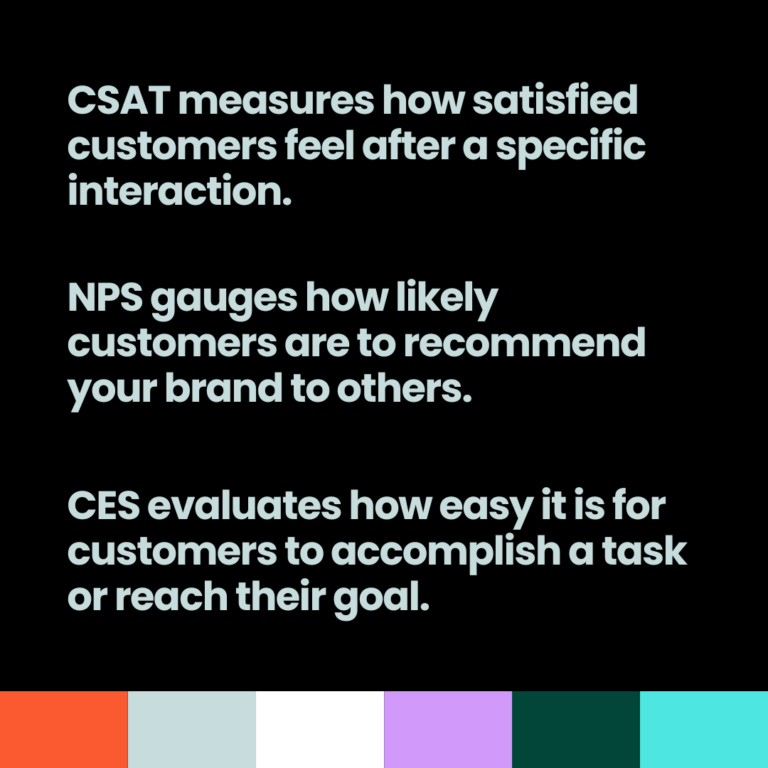
Taken individually, CSAT, NPS, and CES each tell one part of the story. Combined, they provide a complete view of the customer experience: immediate, functional, and relational.
CSAT captures real‑time satisfaction right after an interaction, showing how the customer feels about the experience in the moment.
CES reveals the effort needed to achieve their goal, shedding light on friction points in the journey.
NPS takes a step back to assess how likely the customer is to recommend your brand — a long‑term sign of loyalty and connection.
These three metrics reinforce each other. Too much effort (low CES) drags down satisfaction (CSAT) and ultimately loyalty (NPS). Conversely, a smooth and enjoyable experience boosts both immediate satisfaction and future recommendations.
Using all three isn’t just about tracking scores — it’s about driving action. By cross‑analyzing the results, you can explain performance gaps, identify improvement levers, and directly link operational efforts to your brand’s overall success.
| Advantage | Importance | Impact |
|---|---|---|
| Simplicity | Easy to ask and answer | Quick adoption |
| Real‑time feedback | Instant measurement | Fast detection of issues |
| Benchmarking | Compare easily | Clarifies priorities |
| Actionable data | Highlights where to act | Efficient action plans |
| Versatility | Fits all interactions | Broad experience coverage |
One question, one score, one decision.
Instant visibility on issues such as delivery delays or support quality.
Helps position your brand within your market.
Clearly identifies what requires improvement.
Applies to support, purchase, product use, delivery, onboarding, and more.
| Limitation | Meaning | Impact |
|---|---|---|
| Short‑term view | Measures immediate emotion | Lacks long‑term insight |
| Not explanatory | A number does not say why | Risk of misinterpretation |
| Extreme bias | Mostly very happy or very upset respondents | Distorted reality |
| External influences | Context affects score | Wrong readings |
| Simplistic categorization | Positive vs negative hides nuance | Poor decision‑making |
Le CSAT mesure l’instant T, pas la relation. Un client peut adorer son expérience aujourd’hui puis quitter votre marque trois mois plus tard parce qu’il a trouvé une alternative plus pratique, plus rapide, ou moins chère.
Ce que le CSAT ne montre pas :
C’est pour cette raison que le CSAT doit toujours être croisé avec d’autres indicateurs comme le NPS ou les analyses de churn. Sinon, vous naviguez avec une seule lampe de poche dans une pièce immense.
Un 3/5 ne vous dit… rien.
Était-ce le produit ? Le packaging ? Le délai ? L’humeur du client ? Une mauvaise journée au bureau ?
Un chiffre seul est un résultat sans explication, et c’est l’un des grands pièges du CSAT.
La solution est simple et redoutablement efficace : ajouter une question ouverte, même très courte. « Pouvez-vous nous en dire plus ? »
Ces quelques mots transforment un score muet en un feedback exploitable. C’est souvent là que se cachent les insights les plus précieux.
Le CSAT attire principalement les clients qui ressentent quelque chose de fort :
Le client moyennement satisfait, celui qui a eu une expérience “normale”, répond rarement. Il lit l’email, hésite, referme. Silence radio.
Résultat :
Votre mesure sur-représente les extrêmes et ne reflète pas toujours le ressenti du “client moyen”, celui qui fait pourtant 80 % de votre business.
Le CSAT n’est pas isolé du monde. Il prend aussi les coups des circonstances extérieures.
Moralité : n’interprétez jamais un score isolé. Analysez les tendances sur plusieurs semaines ou mois. La stabilité dit plus que la photo du jour.
La méthode classique du CSAT (4–5 = satisfaits, 1–3 = insatisfaits) masque une réalité plus nuancée.
Un client qui met 3/5 n’est pas dans le même état d’esprit qu’un client qui met 1/5 :
Les traiter comme un seul et même groupe est une erreur stratégique : on ne soigne pas un simple rhume comme une fracture.
The Customer Satisfaction Score (CSAT) should never be seen as an end in itself, but rather as a quick diagnostic tool. Taken alone, it reflects immediate customer sentiment; combined with other data, it becomes a powerful driver of continuous improvement.
In practice, effective CSAT management relies on three key principles:
Companies that truly get value from CSAT are those that know how to listen, understand, and respond before small irritations become losses. In a world where customer loyalty is earned at every interaction, immediate satisfaction remains the best starting point for building a lasting and memorable experience.
Discover how we can optimize your relational strategy with an innovative, tailor‑made model.
Join the leaders who trust our multilingual and technological expertise.