

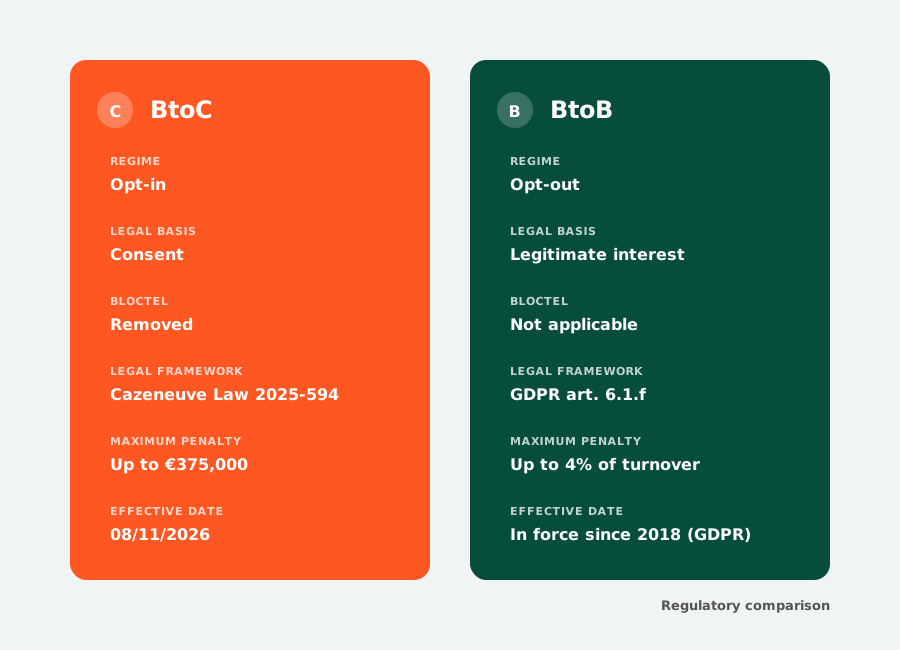
Since 11 August 2026, sales representatives have no longer been permitted to call private individuals without their explicit consent. The Cazenave Act has shifted the entire B2C sector to an opt-in model, and Bloctel has been abolished as a result. However, if your teams are cold-calling businesses, this reform does not apply to you. B2B telemarketing remains governed by an older and less dramatic piece of legislation: the GDPR, supplemented by the CNIL’s guidance on legitimate interest. Here’s what’s changing, what’s staying the same, and what you need to check before picking up the phone.
Why the Cazenave Act does not apply to B2B
Law No. 2025-594 of 30 June 2025 has a title that says it all: it combats fraud involving state aid. Article 13, which reforms telephone canvassing, addresses a specific problem: scams relating to the CPF, energy-efficiency renovations and the ‘one-euro insulation’ scheme, which have targeted millions of individuals in recent years.
The text makes no mention whatsoever of business-to-business relations. Its implementing decree, published on 23 July 2026, sets out the framework for obtaining and withdrawing consumer consent. Nothing in it alters the rules applicable to a request made to a purchasing manager or an IT manager in the course of their duties.
The result is that two legal systems have coexisted since 11 August 2026, and they have almost nothing in common.
What actually makes B2B cold calling permissible: legitimate interest
No French law states in so many words that “business-to-business marketing is permitted without consent”. It is a legal doctrine, developed by the CNIL on the basis of the GDPR, which establishes this principle. Article 6(1)(f) of the GDPR recognises legitimate interest as a legal basis for data processing, including for commercial prospecting, provided that this interest does not override the rights of the person being contacted.
The CNIL has clarified what this means in practical terms for telephone calls: cold calling of business professionals may be based on the legitimate interest of the company making the call, provided that the purpose of the call is related to the profession of the person being contacted. A call to a finance director to present accounting software falls within this framework. A call about the same software made to that same director’s personal number, outside any professional context, no longer falls within it.
This principle is set out and explained in detail in the CNIL guidance on the management of commercial activities, published in 2021. It is the most directly useful resource for developing compliant B2B marketing practices, far more so than a simple information page on the cnil.fr website.
Three conditions that must be met – not just an option
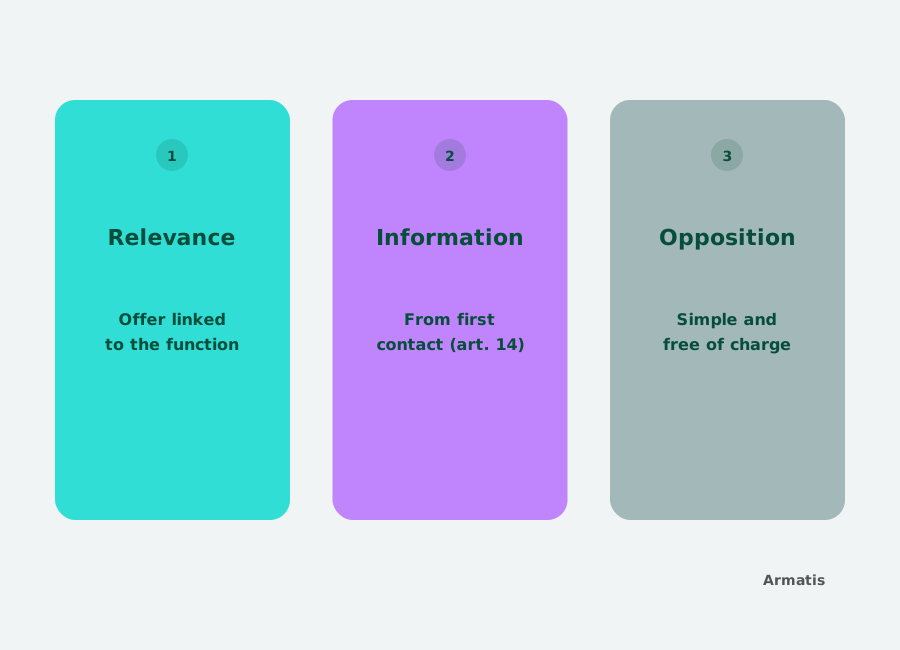
Legitimate interest is not a blank cheque. It is always accompanied by three obligations:
- Professional relevance. The offer must be directly relevant to the role of the person being approached. Approaching an HR manager about an invoicing tool does not carry the same legal weight as contacting them about payroll software.
- Information from the very first point of contact. Article 14 of the GDPR requires that the source of the data, the purpose of the processing, the legal basis used and the data subject’s rights be disclosed, even in summary form at the bottom of an email or at the end of a call.
- The right to object, which is straightforward and free of charge. Individuals must be able to object at any time, without having to give a reason and at no cost, from the moment their contact details are collected and on each subsequent occasion they are contacted.
Telephone, email, text messages: the rules aren’t the same
One point that many sales teams get wrong is that B2B practices vary depending on the channel used.
The traditional telephone call, with a human being at the other end of the line, is not governed by any specific legislation. It is regulated solely by the GDPR and the CNIL guidelines described above.
Email, text messages and automated calling systems are also governed by Article L34-5 of the French Postal and Electronic Communications Code. This provision prohibits, in principle, direct marketing via these channels to a natural person without prior consent. However, it provides for a major exception, which is used on a daily basis by B2B sales teams: marketing remains permissible without consent if the contact details were collected during a previous sale or service provision, if the offer relates to similar products or services, and if a simple right to opt out is provided with each communication. This is known as the ‘existing customer’ exception.
A recent development is worth noting here. A decision of the Constitutional Council dated 25 June 2026 declared several paragraphs of Article L34-5 to be contrary to the Constitution, namely those governing the system of sanctions and the relationship between supervisory authorities. Their repeal has been deferred until 31 October 2027: the text therefore remains fully applicable until then, with a transitional regime that prevents double prosecution for the same offences. This does not alter the substantive obligations for a company engaged in prospecting, but it is a matter your legal teams would be well advised to monitor.
The case of generic addresses and personal numbers
An address such as contact@entreprise.fr or info@entreprise.fr does not constitute personal data. It does not refer to any identified natural person. The CNIL is clear on this point: such addresses are not subject to the rules governing the marketing of natural persons, including professionals.
Conversely, an address in the format nom.prenom@entreprise.fr or a business mobile number identifies an individual. They fall within the scope of the GDPR, even in a B2B context. This distinction is significant when compiling a prospecting database: it determines whether a record in the database is subject to the obligations regarding information and the right to object, or not.
A company’s main switchboard number follows the same principle as generic email addresses: it does not identify any specific individual. An employee’s personal mobile number, even when used for work purposes, remains personal data that requires the same level of care as a personalised email address.
What hasn’t changed, and what’s changing all the same
On paper, there is nothing to oblige B2B sales teams to change their practices as of 11 August 2026. The legal structure remains the same as it was yesterday. But to stop at this interpretation would be a mistake in analysis.
The decision-makers your sales staff try to reach during the day are also private individuals who, in the evenings, are receiving fewer and fewer unsolicited calls at home. Their overall tolerance for cold calling is waning, even when they answer the phone in a professional capacity. A practice that remains legal may become culturally more difficult to accept, simply because social norms have changed on the other side of the coin.
This is something that marketing and sales teams would be well advised to take into account in their scripts and the frequency of their communications, regardless of any new legal requirements.
What to check before launching a B2B campaign
| Checkpoint | A question to ask yourself |
|---|---|
| Nature of the enquiry | A generic company address or identifiable personal contact details? |
| Relevance of the offer | Is the offer relevant to the contact’s actual role? |
| Channel used | A phone call, or an email/text message/automated message subject to the L34-5 Act? |
| Information provided | Have the source of the data, the purpose and the legal basis been stated? |
| Opposition | Is there a simple and free way to object? |
| Length of contact | Has the prospect replied yet, or have they been inactive for more than three years? |
FAQ: B2B sales – the questions we’re asked
Does the Cazenave Act apply if I am canvassing a self-employed person or a member of a liberal profession?
It depends on the context of the call, not just on the person’s status. A business call made to a chartered accountant regarding their professional activities falls under the B2B category. The same number, when contacted for an enquiry unrelated to their professional activities, may be interpreted as B2C. It is advisable to always ensure that the enquiry is clearly framed within a professional context.
Can I ring a decision-maker’s personal mobile without their consent?
It is not prohibited in principle, but it is legally more tenuous than a call to the company’s switchboard. A mobile number remains personal data that can be linked to an individual. It is best to reserve this channel for contacts with whom you already have a professional relationship, whilst providing clear information about the origin of the number.
Do I need to remove Bloctel from my B2B processes?
Bloctel has never applied to B2B. This opt-out list was intended exclusively for private individuals’ numbers. Its abolition, due to come into effect with the Cazenave Act, therefore has no impact on your B2B campaigns.
How long should I keep a professional contact who never replies?
The CNIL recommends retaining data for a maximum of three years after the last contact in the case of a prospective customer who has not responded. Once this period has elapsed, the data must be deleted or reactivated by means of a new data collection exercise.
What are the risks for a company that carries out B2B prospecting poorly?
Not the DGCCRF fines applicable to B2C. The risk lies in the standard GDPR areas: failure to provide information, lack of a demonstrable legal basis, and failure to comply with an objection. CNIL penalties can reach the GDPR maximum limits, although cases involving strictly B2B activities that result in heavy penalties remain less common than those involving the general public.
Compliance that is managed, not merely declared
The CNIL received 973 complaints relating to commercial marketing in a single recent year, across all channels: email, text messages, post and telephone. The main reason? People were unable to exercise their right to object. Whilst this figure mainly relates to B2C, it also highlights a truth for B2B: the sticking point is almost never the legality of the initial contact. It is the ability – or inability – to process a request to stop receiving marketing communications.
The difference between a company that conducts B2B sales with confidence and one that takes a risk is never the law itself. It is the ability to document every call, every email and every objection dealt with. Legitimate interest is only valid if the company can prove, in the event of an inspection, that it has complied with the three conditions attached to it. A well-maintained sales database is no longer merely a performance tool. It is a piece of evidence.
Sources
- CNIL, Telemarketing (excluding automated calls): cnil.fr
- CNIL, Marketing via email, SMS, MMS and automated calling systems: cnil.fr
- CNIL, Guidelines on the processing of personal data for the purposes of managing commercial activities, 2021: cnil.fr
- CNIL, annual report on complaints received regarding commercial marketing: cnil.fr
- Légifrance, Article L34-5 of the Postal and Electronic Communications Code
- Légifrance, Act No. 2025-594 of 30 June 2025 on combating all forms of fraud relating to public aid
- Constitutional Council, Decision No. 2026-1210 QPC of 25 June 2026