

A traveller who walks through the door of their hotel has already experienced half of their customer journey. They have compared options, read reviews, hesitated, booked, and sometimes cancelled and then rebooked. The customer experience in tourism now hinges on five expectations: genuine personalisation of the journey, well-being as the foundation of the stay, authenticity and local roots, proven and consistent sustainability, and technological fluidity that never overshadows the human touch. What these five expectations have in common is that none of them begins on arrival, and none of them ends on departure.
This is not just a passing trend. It is a fundamental shift, confirmed by major sector-specific studies published in 2026, which is permanently reshaping the relationship between travellers and brands. Demand, for its part, shows no sign of waning: international tourist arrivals rose by 5 per cent in the first half of 2025, according to UNWTO. What has changed is the level of expectation. Today’s travellers expect tourism brands to offer the same seamless experience as that found in e-commerce, and the same personalised attention they would receive from a host who knows them. For companies, platforms, tour operators and hoteliers, this shifts the focus: customer relations are no longer just about after-sales service for the trip. They are the trip itself.
Here are the five key expectations, what the research says about them, and, above all, how they affect those whose job it is to manage relations with travellers.
1. Genuine personalisation, not just cosmetic changes
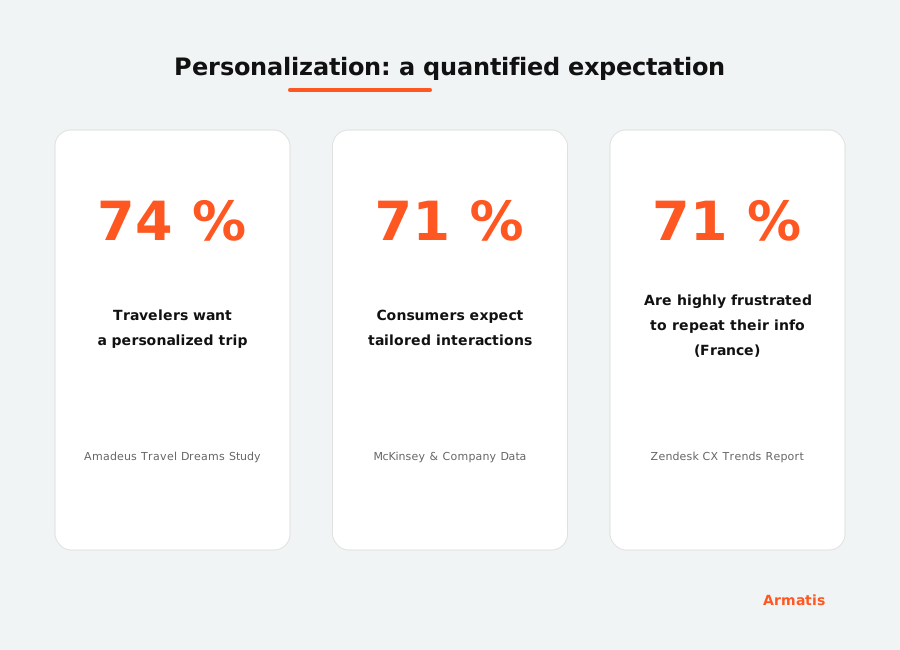
A first name in the subject line of an email no longer fools anyone. Amadeus’s Travel Dreams 2026 study, conducted amongst 6,000 travellers and 500 hotel managers in nine countries including France, reveals an unambiguous figure: 74 per cent of travellers want personalised stays. They are willing to pay for touches that reduce hassle and put them back in control, such as an early check-in, a late check-out or a room set up according to their preferences.
This phenomenon extends far beyond the hospitality sector. McKinsey estimates that 71 per cent of consumers expect personalised interactions, and that 76 per cent feel frustrated when this is not the case. The personalisation expected today is not just a marketing gimmick. It is the ability to recognise the customer at every point of contact.
When it comes to customer relations, this is where it all comes down to. A traveller who has reported a delayed flight via live chat does not want to have to repeat their story over the phone the next day. This requires data to be consistent across all channels and agents to be equipped to access the customer’s history in real time. In France, 71 per cent of consumers say they are very frustrated at having to repeat their details, according to Zendesk’s CX Trends 2026 report. Personalisation isn’t a marketing project. It’s a data architecture designed to support agents who know exactly who they’re talking to.
2. Well-being as the cornerstone of the stay, not just an option
The role of travel has changed. It is no longer just a pleasant break; it has become a means of mental recovery. The Amadeus study confirms this: 41 per cent of travellers hope to return from their holiday with a calmer nervous system, and a third describe their ideal destination as a place that encourages them to switch off.
The same is true for France. According to the fourth edition of the American Express Lifestyle Trends Observatory, conducted by OpinionWay in April 2026, the ideal holiday is first and foremost about taking one’s time and relaxing (54 per cent), switching off from everyday life (50 per cent) and recharging one’s batteries, both mentally and physically (49 per cent). Well-being is no longer just an add-on sold at the spa. It is the central promise.
This shift has a direct impact on customer relations, which is often overlooked. A traveller seeking peace and quiet is even less tolerant of friction. A long wait on the phone, conflicting information across different channels, a complaint that drags on: each of these irritants undermines precisely what the customer came in search of. Selling relaxation requires delivering a soothing customer experience. The quality of service becomes an integral part of the promised sense of well-being, not a separate cost centre.
3. Authenticity and local roots
Travellers in 2026 no longer collect destinations. They seek out the experiences they offer. According to a survey by the Minor Hotels group, reported by Bpifrance, 83 per cent of travellers consider cultural immersion to be a key factor in their travel plans. Marriott International’s ‘Ticket to Travel 2026’ study observes the same trend in response to overtourism: 59 per cent of travellers have opted for unspoilt destinations off the beaten track.
In France, the American Express Observatory confirms this trend. 60 per cent of French people rank discovering new landscapes as the top experience that makes a trip memorable, ahead of historical and cultural sites (47 per cent) and local cuisine (45 per cent).
When it comes to customer relations, authenticity isn’t just about the product. It’s about the advice given. An adviser who can recommend a local experience, refer a customer to a trusted service provider or tailor a holiday to a specific desire becomes a direct extension of the brand’s promise. In a sector where AI generates itineraries in a matter of seconds, human value is shifting towards what machines cannot do: understanding a vague intention, reassuring a customer about a choice, and adding the subtle touch that transforms an ordinary holiday into a memory. Providing advice is once again becoming a profession.
4. Proven and consistent durability
Environmental commitment is no longer merely a matter of added value. It has become a deciding factor – and, above all, a test of credibility. Amadeus’s ‘Travel Dreams 2026’ study shows that three-quarters of travellers take environmental credentials into account when choosing their accommodation, and that those who prioritise sustainability are willing to pay an average of 11.7 per cent more per night.
But the expectation is not about rhetoric. It is about consistency. A long-standing promise undermined by a neglected customer experience has the opposite effect to that intended. Endless refund delays, support that cannot be reached, a complaint that is ignored: these are all signs that contradict the responsible message displayed on the homepage.
This is a common blind spot. Brands invest in demonstrating their product’s environmental credentials but forget that customer relations are part of that demonstration. Sustainability is also demonstrated through the clarity of the information provided before departure, in the handling of disputes, and in the consideration shown in every interaction. Travellers do not expect brands to be perfect. They expect brands to be consistent, from the very first click to the reply to the very last email.
5. Technological fluidity that does not overshadow the human element
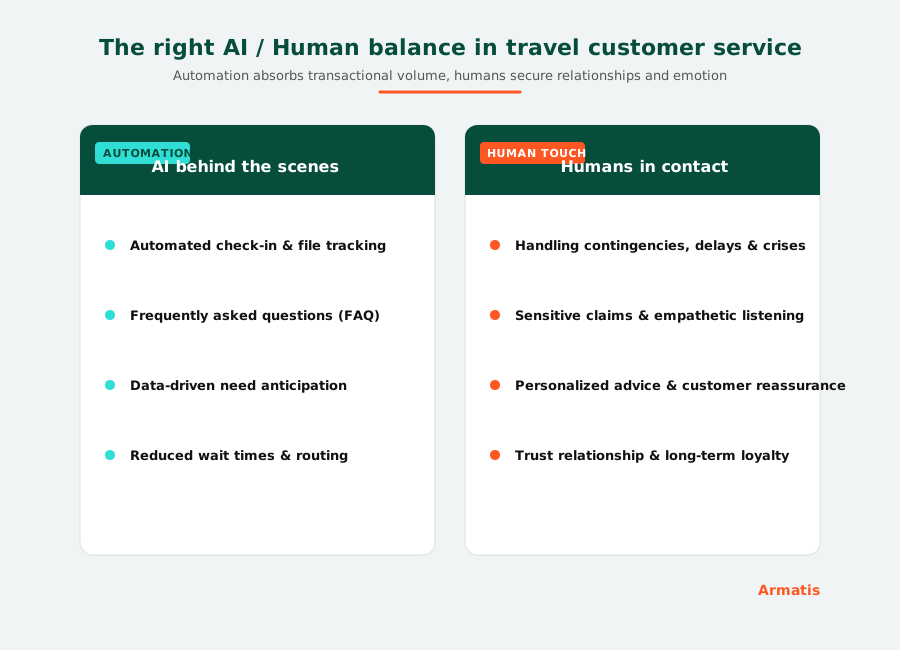
This is the most strategic – and the most misunderstood – expectation. Travellers want technology that simplifies everything, and a human connection that remains available when it matters. Both, not one at the expense of the other. Amadeus is clear on this point: travellers still value human contact; they want to be welcomed, helped and looked after. AI, on the other hand, must work behind the scenes, reducing waiting times, anticipating needs and helping teams to respond more quickly.
Expectations regarding responsiveness, meanwhile, have skyrocketed. According to Zendesk’s CX Trends 2026 report, which surveyed 6,182 consumers and 5,115 professionals across 22 countries, 74 per cent of consumers want a service available 24 hours a day, and 88 per cent expect faster responses than they did a year ago. In France, 85 per cent of CX managers note that a problem not resolved at the first point of contact is enough to drive a customer away.
In the tourism sector, this requirement is coupled with a unique emotional dimension. A cancelled flight, a missing booking, an unexpected weather event: travellers are not just looking for a solution; they are seeking reassurance. This is what makes customer relations in the sector so distinctive, amidst seasonal peaks, unforeseeable events and highly strung customers – a reality we had already described in our analysis of the changing landscape of customer relations in tourism.
The right approach, therefore, does not pit AI against humans. It brings them together. Automation handles simple, repetitive tasks, such as check-ins, case tracking and frequently asked questions. The human adviser focuses on what adds value: the unexpected, emotion, sensitive complaints, and customers who need a human touch. McKinsey puts it this way in its research on agent-based AI applied to the travel sector: technology can reduce friction throughout the entire customer journey and make personalisation scalable, provided that it enhances human contact rather than replacing it.
How these expectations are changing for customer relations, CX and digital departments
First shift: visibility. According to Amadeus, 69 per cent of travellers rely solely on summaries generated by AI search engines when making their choices. What AI says about a brand depends directly on its content, customer reviews and the quality of the responses it provides. Customer relations are becoming a source of reputation, not just a means of resolving issues.
Second shift: investment in technology is massive and virtually universal. According to Amadeus, only one in 500 hoteliers surveyed does not plan to invest in AI by 2026 – that is, 99.8 per cent of the sector. The question is no longer whether to automate, but where to strike a balance between machine efficiency and human value.
The third shift: organisation. Meeting these five expectations requires systems capable of handling seasonality, supporting multiple languages and time zones, unifying customer data across channels, and maintaining the quality of customer relations during both peak periods and crises. This is precisely what brands in the sector are looking for in a specialist partner. Our Travel and Leisure expertise covers the entire customer journey, and players such as eSky Group bear witness to this: customer relations have become a driver of trust and growth, not an area to be cut back on.
FAQ: Customer Experience and Tourism in 2026
What are travellers’ main expectations in 2026?
Five key expectations stand out: a genuinely personalised experience, wellbeing as the cornerstone of the stay, authenticity and local roots, proven and consistent sustainability, and seamless technology that preserves human contact. They all have one thing in common: they come into play before, during and after the stay, and directly shape the customer relationship.
When does the customer journey begin in the tourism sector?
Right from the very first online search. Travellers compare options, read reviews and plan their trips weeks in advance. According to American Express, 91 per cent of French people believe that thorough preparation makes for a more stress-free trip. The pre-trip phase is a crucial part of the customer experience, yet one that is often neglected by brands.
Why is responsiveness so crucial in customer relations within the travel sector?
Because expectations have risen: 88 per cent of consumers expect faster responses than they did a year ago, and 85 per cent of French CX managers find that a problem not resolved at the first point of contact is enough to drive a customer away (Zendesk CX Trends 2026). In the tourism sector, where every unexpected event carries emotional weight, the speed of response is key to building trust.
How can AI and human interaction be reconciled in the tourism sector?
By keeping AI behind the scenes and putting people at the forefront. AI anticipates needs, streamlines journeys and equips advisers; humans welcome guests, offer advice and manage emotions and unforeseen circumstances. Studies all point to the same conclusion: travellers want less friction, not less human interaction.
Does sustainability really influence travellers’ choices?
Yes. Three-quarters of travellers take environmental considerations into account when choosing their accommodation, and those who prioritise sustainability are willing to pay an average premium of 11.7 per cent per night (Amadeus Travel Dreams 2026). However, the key requirement is consistency between words and actions, including in customer relations.
The journey begins before you set off
Personalisation, wellbeing, authenticity, sustainability, fluidity: the five expectations of travellers in 2026 all point to a single requirement – that of a seamless relationship, from the very first click right through to the end of their stay. Brands that master this turn every interaction into a competitive advantage. Do you operate in tourism, transport or leisure? Discover how Armatis supports players in the travel and leisure sectors throughout the entire traveller journey.
Sources
- Amadeus, Travel Dreams 2026: From data to delight (6,000 travellers, 500 hoteliers, 9 countries): amadeus.com
- Zendesk, CX Trends 2026 (6,182 consumers, 5,115 professionals, 22 countries): cxtrends.zendesk.com
- American Express, Lifestyle Trends Survey, 4th edition (OpinionWay, 1,006 French people, April 2026): official press release
- McKinsey, ‘The future of agentic AI in travel and hospitality’: mckinsey.com
- Bpifrance Big Media, Tourism 2026 (in partnership with Minor Hotels, Marriott and UNWTO): bigmedia.bpifrance.fr